From Practice to Policy: What Three Conversations Taught Us About Protecting Family Land

This spring and summer, the Center for Heirs’ Property® (CHP) hosted its first-ever policy webinar series — three conversations rooted in two decades of direct legal and landowner support and shaped by the voices of the families at the center of it all. This is what we heard, and why it matters.
CHP’s policy work grows out of more than two decades of listening to families and helping them protect their land. It comes from years of sitting across a table from a family trying to understand why they can’t qualify for disaster assistance on land their great-grandparents built. It comes from listening to a landowner explain how clearing a title he’d spent years pursuing suddenly tripled his property tax bill. It comes from watching what happens when the legal system and the lived experience of a community collide, and then asking the harder question: what do we do about it?
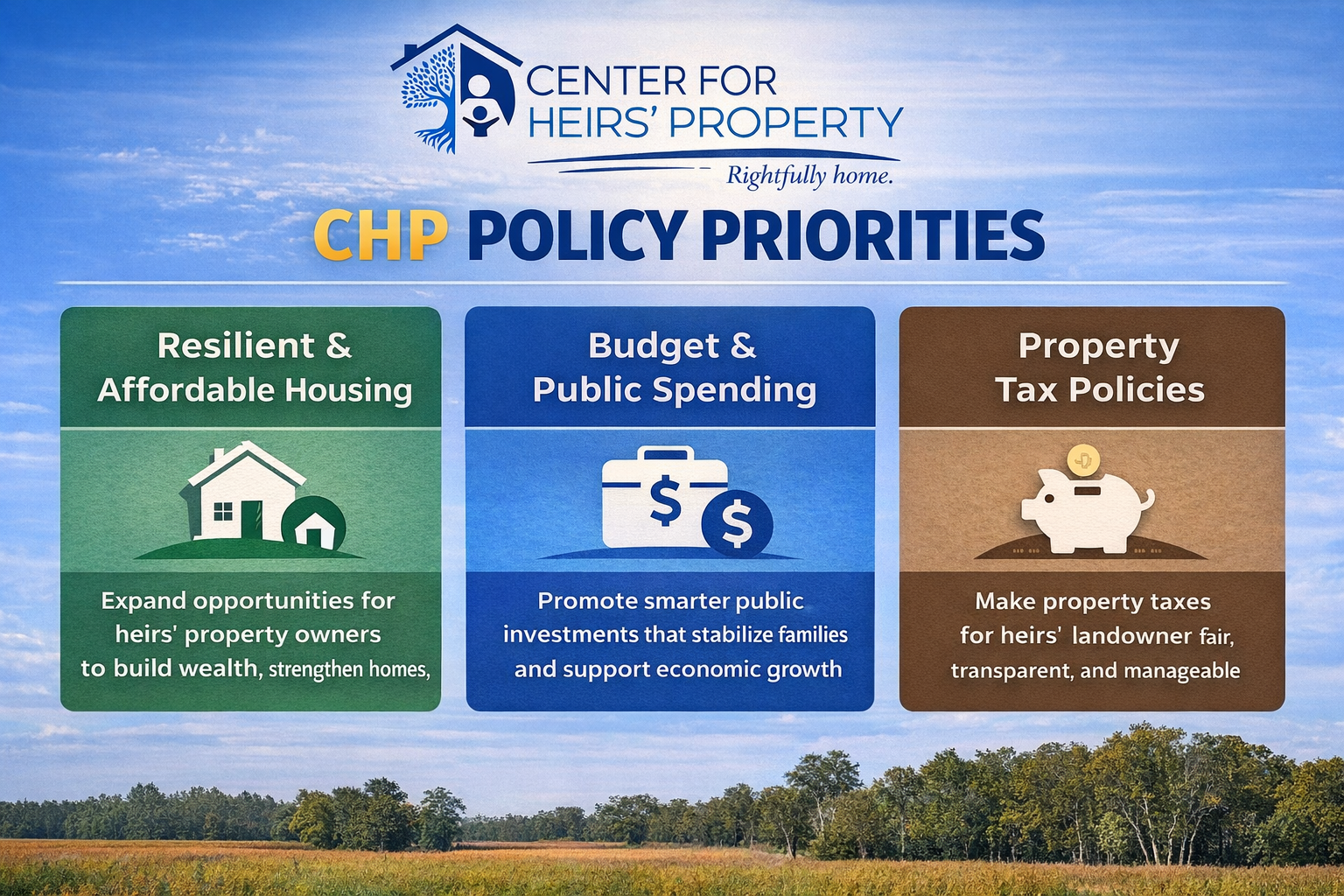
The series covered three policy priorities: property tax relief, resilient and affordable housing, and budget appropriations and public spending. Each webinar brought a different panel of voices into the room. And across all three conversations, a clear throughline emerged: heirs’ property is a complex issue at the intersection of family and history, land management, and economics, and it demands legal and policy solutions, built in close relationship with the families most affected.
The Tax Problem Nobody Warned Them About
Imagine a family spends years working through the legal process to clear the title to land that has been in their family for generations. As part of that process, heirs’ property may be divided so family members can own their own pieces of the land. Each new property gets its own tax map number.
Then the tax bill arrives.
Richard Habersham had seen what could happen next. A longtime leader in the historic Phillips Community in Charleston County, Habersham saw families work to clear title and divide their heirs’ property, only to face much higher property taxes afterward.
That created a serious problem. Families were being encouraged to clear title so they could protect their land. But doing so could lead to a tax increase that made the land harder to afford.
Habersham brought the problem to the Center for Heirs’ Property (CHP), Habitat for Humanity South Carolina and the Charleston-area Habitat for Humanity affiliate.
During the first From Practice to Policy webinar, Habersham shared one example. A family had been paying about $900 a year in property taxes. After the property was divided and reassessed, one owner was paying more than $6,000 a year.
Habersham worried about what would happen to the land in the future. Would the next generation be able to afford those taxes? Or would they have to sell land their family had worked so hard to protect?
That concern helped lead to a change in state law.
CHP worked with Habitat for Humanity South Carolina and the South Carolina Office of Resilience to educate lawmakers and other leaders about the problem. Together, they helped shape legislation to address it.
The result was the South Carolina Heirs’ Property Tax Relief Act, H.4477.
The new law protects families in two important ways. First, certain transfers between family members that are made to clear heirs’ property title will not trigger a new tax assessment. Second, the law protects families when heirs’ property is divided into separate pieces, a process known as partition. The newly created properties can keep their share of the original property’s assessed value instead of being immediately reassessed at full market value.
The bill received strong bipartisan support. The South Carolina House voted 114–0 to approve the Senate’s changes, and Gov. Henry McMaster signed the bill into law on May 15, 2026.
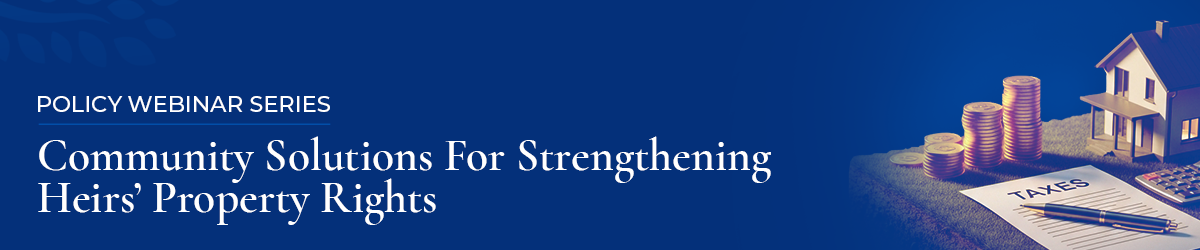
The new law removes a financial barrier that worked against the very thing families were being encouraged to do: clear title, establish ownership and protect their family land for future generations.
It also shows how policy change can begin with the people most affected by a problem.
A community leader saw something hurting families and spoke up. He brought the problem to organizations that had the legal knowledge, policy experience and relationships to help. Those organizations listened, worked with lawmakers and other partners, and helped turn a community concern into a change in state law.
Other community partners continue to play an important role. The Lowcountry Gullah Foundation has helped make landowners aware of the new law. It also worked with CHP on an earlier effort to address a separate issue involving the tax-sale redemption process. CHP and Habitat for Humanity South Carolina plan to return to that issue with lawmakers.
That distinction is important. Protecting family land takes many organizations working together, and different partners may play different roles along the way.
But the work starts in the same place: listening to the people who are living with the problem.
That’s how we turn practice into policy.
Sign on to CHP’s policy agenda at heirsproperty.org/policy-agenda and add your voice to the work.
Watch the full first webinar series here: From Practice To Policy: Community Solutions For Strengthening Heirs Property Rights
When Disaster Hits and the Door Is Closed
The second webinar widened the lens. If the first conversation was about what happens when families try to clear the title, this one was about what happens when they can’t, and a disaster arrives anyway.
The research is stark. Heirs’ property owners are significantly less likely to carry homeowners insurance, often because they don’t have a mortgage and often because income won’t stretch to cover it. Their homes are more likely to have deferred maintenance—aging roofs, plumbing issues, structural vulnerabilities built up over decades without access to repair programs. When a flood or a tornado or a hurricane comes through, they’re frequently turned away from the very programs designed to help them, because their name isn’t on a deed.
Disaster response attorney Erica Fields works with survivors in Eastern Kentucky — one of the most heirs’ property-dense regions in the country, and described a system that tries to be flexible but falls short in practice. The Federal Emergency Management Agency (FEMA) has made efforts to accommodate heirs, but the standards aren’t consistently applied. “You can very easily have two different case workers come up with two completely different results on an appeal,” she said. That’s not a policy problem families can solve on their own.
However, the South Carolina Office of Resilience proved something important: it doesn’t have to work that way. Since the 2015 floods, their office has completed over 3,460 home repair and replacement projects — building to an enhanced standard, with better roofs, stronger connections from roof to foundation, and impact-resistant windows. By establishing a threshold of “sufficient evidence of ownership” rather than requiring a clear deed upfront, they’ve been able to serve the families who need them most.
“We can build that person a brand-new home. And we didn’t want someone to get a brand-new house and lose it in a tax sale three years later, so we worked with the legislature to hold the tax basis the same for the generation we serve.”
– Eric Fosmire, Chief of Staff & General Counsel, South Carolina Office of Resilience
That’s Eric Fosmire, General Counsel at the SC Office of Resilience. It’s a sentence that captures everything the webinar series is trying to say: that practical solutions exist, that common-sense and bipartisan legislation can address the issue, and that the people doing this work are willing to share what they’ve learned. Their policies and procedures are on their website — openly published, free to adapt.
If your organization works with disaster survivors or rural housing programs, CHP wants to connect with you. Visit heirsproperty.org to learn more.
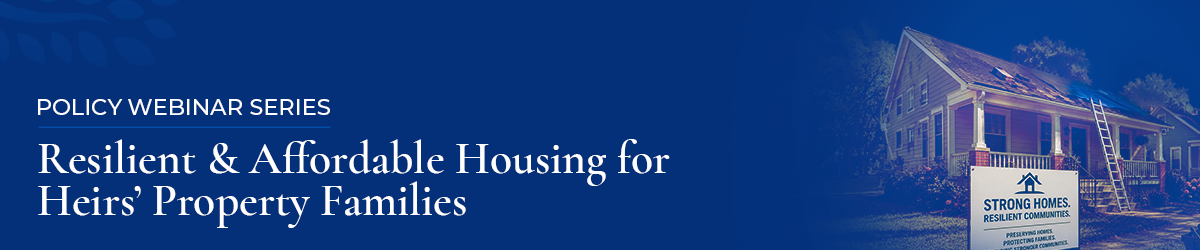
Watch the full second part webinar series here: From Practice To Policy: Resilient & Affordable Housing For Heirs Property Families
Follow the Money
The final webinar tackled the question underneath all the others: even when the right policies exist, what happens if they’re never funded?
“Your budget shows your priorities. You can talk all day about stuff, but where is your money going?”
– Karama Neal Ph.D, Principal, Neal Firm
Dr. Karama Neal, a consultant, former USDA Rural Business-Cooperative Service official, and member of a family that owns heirs’ property, , didn’t mince words. Programs that exist on paper without adequate appropriations don’t serve families. Rules that technically allow heirs to access assistance mean nothing if the caseworker has never been trained on them, or if the local office runs out of funding in February.
Georgia State Senator Kim Jackson knows this firsthand. A Black farmer and multi-generational landowner whose own family has spent decades trying to clear title on property in Virginia, she spent her first year in the Georgia Senate navigating a complex budget process to secure $500,000 for heirs’ property and land access work in Southwest Georgia.
“The budget process is designed to be confusing, and that’s intentional. It’s meant to discourage people from asking for what their communities need. But in every single state legislature in this country, there is someone willing to go to the mat for this work. They just need to know about the issue. Go find that person. Ask for what you need. And keep asking.”
– Senator Kim Jackson, Georgia State Senate, District 41
Attorney Sarah Mancini of the National Consumer Law Center brought the webinar’s most immediately actionable piece: a new report on heirship affidavits as a flexible, accessible tool for proving home ownership without a deed. The premise is simple but powerful — when a homeowner dies, the property doesn’t float in legal limbo. It is immediately owned by the heirs. Programs available to homeowners should be available to them, and a sworn statement, a form, a simple attestation in the county office can be enough to establish that ownership — if counties and agencies are willing to accept it.
Philadelphia has already done it. Parts of Texas have done it. “When you are successful, publish it,” Mancini said. “So other cities and counties can see the sky didn’t fall.”
Year-round civic engagement is the strategy, Dr. Neal emphasized, not just elections or formal comment periods. Letters, office visits, emails, stories—because data informs policy, but stories move people. If you’re an heir, you already have the most powerful tool in the room.
You don’t need a law degree to make a difference here. Sign on to CHP’s policy agenda, share your story with your elected officials, and let them know this matters in your community: heirsproperty.org/policy-agenda.
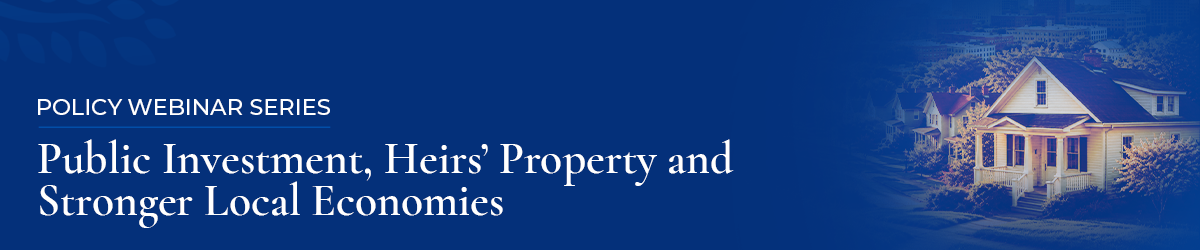
Watch the full third and concluding webinar series here: From Practice To Policy: Public Investment, Heirs’ Property & Stronger Local Economies
What It All Comes Down To
Dr. Jennie Stephens, CHP’s CEO, summarized the series with an observation that stayed true across all three conversations:
“Clearing title is only part of the work. Families also need access to the programs meant to help them. When those programs require ownership documents in the names of living family members, heirs whose documents still name a deceased relative may be unable to access resources their own tax dollars helped fund. “
– Jennie L. Stephens Ph.D, Chief Executive Officer, Center for Heirs’ Property®
That’s the problem, and the series—every panel, every story, every piece of legislation discussed, was an answer to it. Not a complete answer, but a real one, being built in real time, by people whose real-life experience as landowners, policy makers, and within organizations aimed to address heirs’ property, has given them wisdom to share..
A tax bill passed unanimously. A senator in her first year got $500,000 appropriated for communities that needed it. A new legal report gave advocates a tool they can use tomorrow.
The issue extends far beyond family homes – it’s about forests, farms, and other working lands. It’s about legacy and collaboration. And it’s about protecting what matters most for families: the roof over their heads and the land under their feet.
None of it happened alone. All of it started with someone seeing a problem, trusting the right people, and refusing to accept that the system couldn’t do better.
That’s where you come in.
From Practice To Policy: Community Solutions For Strengthening Heirs Property Rights
From Practice To Policy: Resilient & Affordable Housing For Heirs Property Families
From Practice To Policy: Public Investment, Heirs’ Property & Stronger Local Economies
Watch all three webinar recordings, explore the full policy agenda, and find out how to get involved at heirsproperty.org. The roof over a family’s head and the land under their feet are worth protecting. Let’s do it together.